



Table of Contents
- Introduction
- Can You Actually Overdose on Collagen?
- Potential Side Effects of Excessive Collagen Intake
- The Role of Amino Acids and the Tryptophan Gap
- How Much Collagen Should You Take Daily?
- Factors That Influence Your Collagen Needs
- Why Quality Matters More Than Quantity
- Practical Tips for Your Collagen Routine
- Potential Interactions and Precautions
- Conclusion
- FAQ
Introduction
You have probably seen collagen everywhere lately. It is in morning coffees, post-workout shakes, and even evening teas. Most people start taking it to support their joints, skin, or recovery after a hard session. Because it is so easy to mix into almost anything, a common question arises: can you take too much collagen?
When you find a supplement that works, the temptation is to double the dose to see faster results. However, more is not always better when it comes to protein and amino acids. At BUBS Naturals, we believe in using science-backed portions that fit your specific lifestyle and goals. Understanding the upper limits and the ideal range for your body helps you get the most out of every scoop without wasting product or causing discomfort.
This guide will break down the safety of collagen, what happens if you overdo it, and how to find the right daily amount for your specific needs. Whether you are an endurance athlete or someone looking to support healthy aging, finding your sweet spot is the key to long-term success.
Quick Answer: While it is very difficult to "overdose" on collagen in a dangerous way, taking excessive amounts (typically over 40-50 grams daily) may lead to digestive discomfort like bloating or heaviness. For most people, a daily dose of 10 to 20 grams provides the maximum benefit for skin, joints, and recovery.
Can You Actually Overdose on Collagen?
In the traditional sense of a medical overdose, the answer is generally no. Collagen is a food-based protein. It is made up of amino acids that your body already knows how to process. When you consume it, your body breaks it down into individual peptides and amino acids, just like it would with a piece of steak or a bowl of lentils.
However, your body has a limit on how much protein it can effectively utilize at one time for specific tasks. If you consume a massive amount of collagen, your body will simply treat the excess as a source of energy (calories) or filter out the byproduct through your kidneys. While this is not usually harmful to healthy individuals, it is not an efficient use of your supplements.
The main concern with "too much" collagen is not toxicity, but rather digestive efficiency and nutritional balance. Collagen is an incomplete protein. This means it lacks one of the nine essential amino acids—tryptophan. If collagen makes up too much of your total daily protein intake, you might end up with an amino acid imbalance.
Potential Side Effects of Excessive Collagen Intake
Even though collagen is safe for most people, taking way more than the recommended serving size can lead to some minor but annoying side effects. Most of these issues occur in the digestive tract.
Digestive Discomfort and Bloating
The most common report from people who take too much collagen at once is a feeling of being overly full or bloated. Collagen is a dense protein. If your gut is not used to high amounts of supplemental protein, or if you take 40 grams in a single sitting, you might feel a heavy sensation in your stomach. Some people also report mild gas or "acid indigestion" when they significantly exceed the suggested dose.
A Sensation of Heaviness
Because collagen is often used in liquids, drinking a high-protein beverage very quickly can make you feel sluggish instead of energized. This is especially true if the collagen is not hydrolyzed. Hydrolyzed collagen, which we use in all our products, is already broken down into smaller peptides. This makes it much easier on the stomach, but even hydrolyzed peptides have a limit if consumed in extreme quantities.
Altered Taste or Aftertaste
High-quality collagen should be virtually tasteless. However, if you are using a lower-grade product and trying to take three or four scoops at once, you may notice a slight "protein" aftertaste. This is often a sign that you are using more than the liquid can effectively mask or that the quality of the source is not up to par.
Key Takeaway: Your body can process collagen effectively, but excessive amounts usually just lead to digestive heaviness or a "full" feeling. Stick to moderate doses spread throughout the day to ensure your gut stays happy and the protein is used for repair rather than just extra calories.
The Role of Amino Acids and the Tryptophan Gap
To understand why you should not rely on collagen as your only protein source, you have to look at its amino acid profile. Collagen is rich in glycine, proline, and hydroxyproline. These are incredible for connective tissue, skin elasticity, and gut lining.
However, collagen is not a "complete" protein because it lacks tryptophan. Tryptophan is an essential amino acid your body needs to produce serotonin and melatonin. If you decide to take 100 grams of collagen a day and cut out other protein sources like meat, eggs, or beans, you could technically become deficient in tryptophan over time.
This is why we recommend using collagen as a supplement to a balanced diet, not a replacement for all other proteins. It is designed to "top off" your collagen levels and provide the specific building blocks for your joints and skin that you might not get from a standard chicken breast or whey shake.
How Much Collagen Should You Take Daily?
The "right" amount of collagen depends entirely on your goals. There is no one-size-fits-all number, but research gives us some very good starting points based on what you want to achieve.
For Skin Health and Elasticity
If your primary goal is supporting skin hydration and reducing the appearance of fine lines, studies suggest that a lower dose is often sufficient. Many people see results with as little as 2.5 to 5 grams per day. However, a standard 10-gram scoop is a very common and effective baseline for most adults.
For Joint Pain and Connective Tissue
Supporting your joints, tendons, and ligaments usually requires a bit more. Athletes or those dealing with age-related joint stiffness often find success in the 10 to 20-gram range. This provides enough of the specific amino acids (like proline and glycine) to support the repair of the "cushion" in your joints.
For Muscle Recovery and Athletic Performance
If you are training hard, your body is constantly breaking down and rebuilding tissue. Collagen may support the repair of the connective tissues that hold your muscles together. In these cases, 15 to 20 grams taken about 30 to 60 minutes before a workout is a popular protocol. Some heavy-duty athletes go up to 30 or 40 grams spread across the day, but this is usually the upper limit of what is necessary. For additional context, explore this guide to collagen peptides and muscle recovery.
Dosing Comparison Table
| Goal | Suggested Daily Dose | Key Benefit |
|---|---|---|
| General Wellness | 5g - 10g | Supports hair, nails, and gut health. |
| Skin Elasticity | 2.5g - 10g | May support hydration and skin density. |
| Joint Support | 10g - 20g | Helps maintain healthy cartilage and tendons. |
| Athletic Recovery | 15g - 30g | Supports connective tissue repair after training. |
Factors That Influence Your Collagen Needs
Your body is unique. A 250-pound powerlifter has different nutritional requirements than a 130-pound yoga instructor. When deciding if you are taking too much or too little, consider these three factors.
Your Total Protein Intake
If you already eat a very high-protein diet full of bone broth, organ meats, and various animal proteins, you are naturally getting more collagen than someone on a plant-based diet. In this case, you might only need one scoop of BUBS Naturals Collagen Peptides to see a difference. If your protein intake is low, you might benefit from a slightly higher daily dose.
Your Activity Level
Physical stress increases the demand for repair. Long-distance running, heavy lifting, and high-impact sports put a lot of strain on your tendons and ligaments. If you are highly active, your "ceiling" for collagen intake is likely higher because your body is using those amino acids more rapidly to fix micro-tears in connective tissue.
Your Age
As we age, our body’s natural collagen production begins to drop. This usually starts in our 20s and accelerates through our 40s and 50s. Older adults may find that a higher daily dose (closer to 20 grams) helps them feel better than the lower doses they used when they were younger.
Why Quality Matters More Than Quantity
When people ask "can you take too much collagen," they are often worried about the effect on their body. But often, the problem isn't the amount of collagen—it is the quality of the collagen.
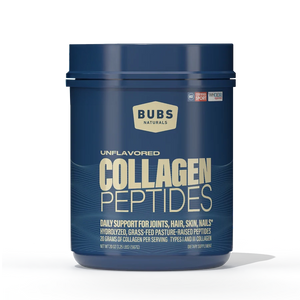
Low-quality collagen supplements can contain fillers, heavy metals, or additives that cause the digestive issues people mistake for a collagen "overdose." This is why we focus so heavily on the sourcing and purity of our products. BUBS Naturals Collagen Peptides are sourced from grass-fed, pasture-raised bovine hides. We make sure the product is hydrolyzed, meaning the long protein chains are broken down into small peptides that your body can actually use. Learn more about the potential benefits of hydrolyzed collagen.
We also prioritize third-party testing. Our collagen is NSF for Sport certified. This is the highest standard for purity and safety, ensuring that what is on the label is exactly what is in the tub—no hidden "BS" or banned substances. When you use a clean product, your body can process it more efficiently, which means you often need less of it to see the same results.
Myth: You need to take 50+ grams of collagen to see real results in your joints. Fact: Most clinical research shows that the body reaches a point of diminishing returns after about 20-30 grams. Consistent daily use of a smaller, high-quality dose is much more effective than occasional "mega-dosing."
Practical Tips for Your Collagen Routine
To avoid the "too much" feeling while still getting all the benefits, how you take your collagen matters as much as how much you take.
1. Start Small
If you are new to collagen, do not start with two big scoops. Start with half a scoop (about 5 grams) for a few days. See how your stomach reacts. If you feel good, move up to a full scoop.
2. Spread It Out
If your goal requires 20 or 30 grams, you do not have to take it all at once. Put one scoop in your morning coffee and another in your post-workout shake or evening tea. This keeps a steady supply of amino acids in your system and is much easier on your digestion.
3. Mix Thoroughly
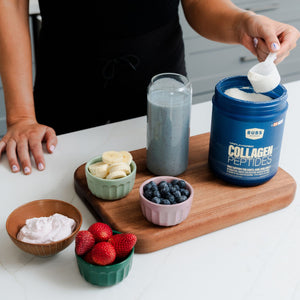
One reason people feel "heavy" after taking collagen is that it wasn't mixed well, leading to clumps that are harder to digest. Our collagen is designed to mix effortlessly into both hot and cold liquids. Give it a quick stir or use a handheld frother to ensure it is fully dissolved.
4. Pair with Vitamin C
Vitamin C is a vital co-factor for collagen synthesis. Your body cannot effectively turn those amino acids into new collagen fibers without it. You do not need to take them at the exact same moment, but having a diet rich in Vitamin C or taking BUBS Vitamin C will make your collagen dose more effective. This allows you to get better results from a smaller, safer amount.
Potential Interactions and Precautions
Collagen is generally recognized as safe, but there are a few specific situations where you should be mindful of your intake.
If you have a history of kidney stones, specifically calcium oxalate stones, you should talk to your doctor before taking high doses of collagen. Collagen contains the amino acid hydroxyproline, which the body can convert into oxalate. While most people have no issues, those prone to stones should stick to moderate doses.
Always listen to your body. If you start a collagen routine and notice skin breakouts or a change in your digestion that does not go away after a few days, try cutting the dose in half. Everyone's microbiome is different, and some people simply process certain proteins more slowly than others.
Bottom line: For the vast majority of people, collagen is incredibly safe. The "upper limit" is generally defined by your digestive comfort rather than a specific toxicity level.
Conclusion
Can you take too much collagen? Technically, yes—but "too much" usually just means you are wasting money or making your stomach feel a little heavy. For the best results, aim for a daily dose between 10 and 20 grams of high-quality, hydrolyzed peptides. This range is well-supported by research to provide the benefits you want for your skin, joints, and recovery without overloading your system.
At BUBS Naturals, we are committed to providing the cleanest, most effective supplements to help you live a life of adventure and purpose. Our mission is rooted in the legacy of Glen "BUB" Doherty, and we honor that by ensuring every product we make is something we are proud to use ourselves. That is why we donate 10% of all our profits to veteran-focused charities. You can continue exploring the topic in this collagen education guide.
When you choose a high-quality, NSF for Sport certified collagen, you can trust that you are giving your body exactly what it needs to stay in the game. Start with a single scoop, be consistent, and listen to how your body responds. You have everything you need to feel your best—one scoop at a time.
FAQ
Is 20 grams of collagen a day too much?
No, 20 grams is considered a standard and safe dose for most active adults. Many clinical studies on joint health and muscle recovery use 15 to 20 grams as the daily baseline. As long as your stomach feels fine, this is an excellent amount to support your wellness goals.
Can taking too much collagen cause skin issues?
While rare, some people report mild breakouts when they suddenly start a very high dose of collagen. This is usually not a reaction to the collagen itself, but rather a result of the body adjusting to a new protein source or an imbalance in amino acids. If this happens, try lowering your dose to 5 grams and gradually increasing it over several weeks.
Does collagen cause weight gain if you take too much?
Collagen is a protein and contains about 4 calories per gram. If you are taking 40 grams of collagen a day, that is 160 calories. While this is unlikely to cause significant weight gain on its own, all supplements should be factored into your total daily caloric needs.
Should I take collagen every day or take breaks?
Consistency is key with collagen because your body’s natural production is a continuous process. Most people see the best results for skin and joint health when they take it daily for at least 8 to 12 weeks. There is no biological need to "cycle" off collagen, as it is a food-based protein that your body uses every day.
Written by:
Collagen Peptides
Fuel stronger workouts and faster recovery with collagen peptides that support joints, muscles, skin, and overall performance.


